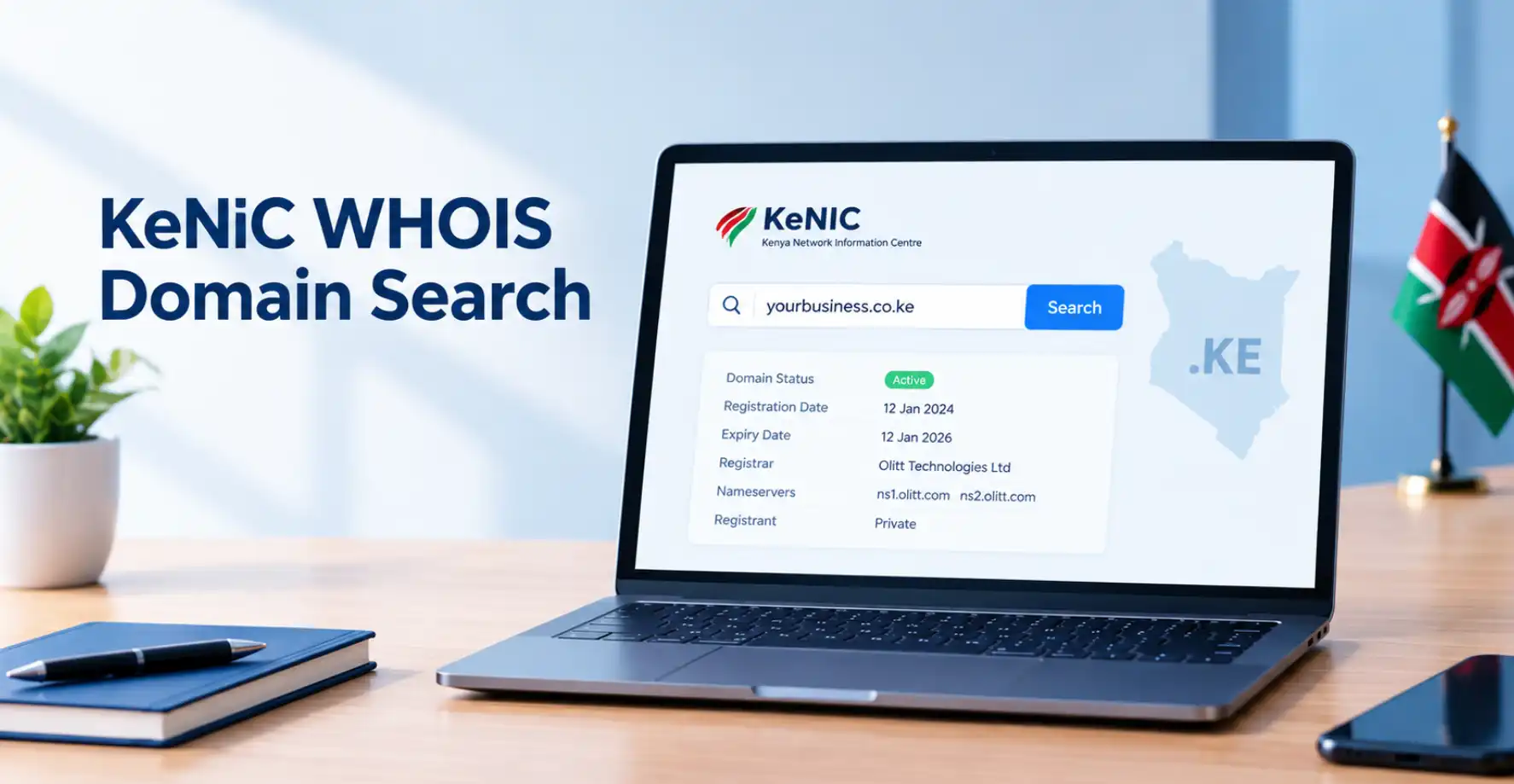

Both end in Kenya’s country code. Both are managed by KeNIC. Both give your website a Kenyan identity online.
So what is the real difference between a .KE domain and a .CO.KE domain, and which one is right for your business?
This guide answers your questions, starting with the core differences, SEO, pricing, branding, and which businesses should choose which.
The 7 Key Differences Between a .KE Domain and a .CO.KE Domain
| Feature | .KE Domain | .CO.KE Domain |
| Domain level | Top-level country code (ccTLD) | Second-level domain under .KE |
| Introduced | 1993 (widely available from 2017) | 1993 |
| Length | Shorter – yourname.ke | Longer – yourname.co.ke |
| Typical use | Brands, personal sites, modern businesses | Commercial entities, businesses |
| Price | Slightly higher | More affordable |
| Name availability | Lower – many short names taken | Higher – more names still available |
| Recognition | Growing fast | Established – widely recognized |
1. Structure: .KE Is the Parent, .CO.KE Lives Under It
The .KE domain is Kenya’s primary country code top-level domain (ccTLD). According to ICANN, ccTLDs are two-letter extensions assigned to specific countries and territories .ke belongs exclusively to Kenya.
The .CO.KE domain is a second-level domain that lives under .ke. The co part signals a commercial entity, much like .co.uk does for British businesses. When someone registers yourname.co.ke, their domain sits one level below the .ke namespace.
In simple terms: .ke is the root. .co.ke branches off from it.
2. Branding Signal: What Each Extension Communicates
Both domains tell Google and visitors that your website is based in Kenya. But they send a slightly different signal beyond that.
A .ke domain reads like a national identity marker. It feels clean, modern, and brand-forward. A business on yourname.ke signals confidence and simplicity – the way a global brand might strip away descriptors and just go by its name.
A .co.ke domain reads as commercial in Kenya. It carries the familiarity of a long-established pattern that Kenyan consumers have recognized for over 30 years. It signals: this is a business operating here.
Neither is better than the other. They are different signals for different brand positions.
3. Price: .CO.KE Is More Affordable
The .ke extension typically costs more than .co.ke. This is because .ke is a premium, shorter domain at the top-level namespace, while .co.ke is a more accessible second-level option.
At Olitt, .co.ke domains are available from as low as Ksh 399 per year with a flat transparent renewal rate. The .ke extension carries a higher price point reflecting its shorter, cleaner format.
For startups, small businesses, and first-time registrants working with a tight budget, .co.ke gives you a fully recognized Kenyan domain at a significantly lower annual cost. Search for your name and check current pricing on both through Olitt’s domain search tool.
4. Name Availability: .CO.KE Has More Options
Because .ke was introduced as a widely available option only from 2017, many desirable short names are still available. But this gap is closing fast.
Kenya had over 124,000 registered .KE domain names as of March 2026. As registration numbers grow, clean names on both extensions become harder to find.
On .co.ke, the namespace is deeper – because longer strings are less likely to already be registered. A business called Savanna Bakers has a high chance of finding savannabakers.co.ke available even today, while savannabakers.ke may already be taken by a brand-forward registrant who grabbed it early.
5. SEO: Both Perform the Same for Local Search
This is where a lot of confusion spreads. Some sources claim .ke ranks better than .co.ke, or vice versa. The factual position is simpler.
Both .ke and .co.ke are Kenya country code domains managed by KeNIC. Google treats both as Kenyan ccTLDs and gives both the same local geographic signal for searches originating in Kenya.
What determines your actual ranking is not which Kenyan extension you use – it is your content quality, site speed, mobile experience, and local backlinks. A well-optimized site on .co.ke will outrank a poorly maintained site on .ke every time.
6. Consumer Recognition: .CO.KE Still Leads
The .co.ke extension has been in active use since 1993. Over three decades, it has become the default expectation for a Kenyan business website.
A survey of Kenyan business owners at networking events in Nairobi consistently shows that when asked which domain extension they trust most for local services, most say .co.ke without hesitation.
The .ke extension is growing fast – particularly among tech brands, startups, and modern personal brands – but it has not yet reached the same instinctive recognition that .co.ke carries with older Kenyan internet users and established business audiences.
7. Availability of Related Extensions
When you register yourname.co.ke, it does not automatically protect yourname.ke. Someone else can register the .ke version of your name at any time.
For brand protection, many Kenyan businesses register both. One becomes the primary domain. The other redirects all traffic to it.
This is smart. What is not smart is running active content on both without redirecting one – because Google will index both versions and treat them as duplicate content, splitting your backlink authority and creating ranking confusion.
Register both. Point one to the other. Keep one primary.
Which One Should Your Business Choose?
Here is a straight decision guide based on what different businesses typically need.
Choose .CO.KE If:
- Your customers are primarily Kenyan and local trust is a priority
- You are a registered commercial business
- You are on a budget and want the most affordable Kenyan domain
- You want strong name availability for your exact brand
- You are building a site for local SEO in Kenya
Choose .KE If:
- You want a short, clean, modern URL for a brand-forward identity
- Your business is in tech, media, or a sector where minimalism signals credibility
- You are targeting both Kenyan and East African audiences
- Your exact name is already taken on .co.ke but available on .ke
- Budget is less of a concern than brand brevity
Choose Both If:
- Your brand is established and worth protecting
- You are running an e-commerce site where losing one visitor to a wrong-extension typo has real cost
- You want a Kenya-specific landing page on .co.ke while keeping the primary brand on .ke
How to Register a .KE or .CO.KE Domain on Olitt
Olitt is a KeNIC-accredited registrar that lets you register both .ke and .co.ke from the same platform, with free WHOIS privacy, M-Pesa checkout, and a built-in AI website builder.
Here is how to register:
Step 1: Go to Olitt’s domain search and search your preferred name. The tool checks live KeNIC availability for both .ke and .co.ke in real time.

Step 2: Review the first-year and renewal price for both extensions before choosing. Olitt displays both figures transparently on the same page.

Step 3: Fill in your registrant details with a permanent business email address you will keep for years.
Step 4: Pay via M-Pesa or card. Your domain activates immediately after payment.
Step 7: Use Olitt’s AI website builder to go from your registered domain to a live business website in under an hour- no coding, no developer needed.
What Other .KE Extensions Are Available?
Beyond .ke and .co.ke, KeNIC manages several other second-level extensions, each designed for a specific type of entity.
| Extension | Intended For | Documents Required? |
| .co.ke | Commercial businesses | No |
| .ke | General use | No |
| .or.ke | Non-profit organizations | Yes – NGO Coordination Board cert |
| .ac.ke | Universities and colleges | Yes – Ministry of Education letter |
| .sc.ke | Schools | Yes – Ministry of Education cert |
| .go.ke | Government institutions | Yes – Treasury authorization |
| .ne.ke | Network providers and ISPs | Yes – Technical documentation |
For most Kenyan businesses, the choice is simply between .co.ke and .ke. The other extensions are restricted to specific entity types and require supporting documents.
Frequently Asked Questions
Do I need documents to register a .KE or .CO.KE domain?
No documents are required for standard .co.ke or .ke registrations. You only need accurate contact details. Other extensions like .or.ke, .ac.ke, and .go.ke require specific supporting documents.
Is .KE better than .CO.KE for SEO in Kenya?
No. Both are Kenya ccTLDs managed by KeNIC and both send the same geographic signal to Google. Your content, backlinks, and site speed determine your ranking far more than which Kenyan extension you use.
Which is cheaper – .KE or .CO.KE?
The .co.ke extension is more affordable. At Olitt, .co.ke starts from Ksh 399 per year. The .ke extension carries a higher price point due to its premium top-level status.
How long does .KE or .CO.KE domain registration take
Registration through a KeNIC-accredited registrar like Olitt is instant after payment. DNS propagation takes between one and four hours in most cases.
Which extension do Kenyan consumers trust more?
The .co.ke extension carries stronger instinctive recognition among established Kenyan business audiences due to its 30-year history. The .ke extension is growing fast and is increasingly trusted among tech-savvy and younger audiences.
Register Your .KE or .CO.KE Domain Today
Both the .KE domain and the .CO.KE domain give your Kenyan business a recognized local identity online. The right choice depends on your budget, your brand position, and your audience.
For most Kenyan businesses starting out, .co.ke is the practical starting point – affordable, widely recognized, and with better name availability. For brands focused on clean, modern URLs and willing to invest in the premium extension, .ke is a strong choice.
Search for your preferred name right now through Olitt’s domain search, check availability on both extensions, and get your Kenyan online presence live today.