
You came up with a perfect .co.ke domain name for your business just to search and find it’s already taken.
That is not the end of the road. There are five proven ways to get a domain that is already registered, walk with me as I guide you on how to.
Why .co.ke Domains Get Taken So Fast
As of March 2026, there are 289,535 registered .ke domains, and that number is growing every month as Kenya’s digital economy expands.
Popular business names, common keywords, and short memorable phrases get registered early. Some are actively used. Some are parked by owners waiting for buyers. Some simply expired and were snapped up before you arrived.
Step 1: Check the WHOIS Record Before You Do Anything Else
Before reaching out to anyone or spending a single shilling, run a WHOIS lookup on the domain.
A WHOIS lookup provides useful information such as the domain’s registrar, registration date, expiry date, and status. In some cases, it may also include contact details for the registrant or an administrative contact, though this information is not always publicly available due to privacy protections.
Start by visiting whois.kenic.or.ke to check the official WHOIS record for any .co.ke domain. The information you find can help you determine whether the domain is active, who manages it, and whether there may be an opportunity to acquire it.
Here is what to look for in the results:
| WHOIS Field | What It Tells You |
| Registrant name | Who owns the domain |
| Registrant email | How to contact them directly |
| Registrar | Which company manages the registration |
| Expiry date | When the domain could become available |
| Domain status | Whether it is locked, active, or suspended |
If the owner has WHOIS privacy enabled, their personal details will be hidden and replaced with placeholder text. In that case, you will need to use a different approach covered below.
Strategy 1: Contact the Owner Directly
This is the fastest and cheapest route when the WHOIS record shows a public email address.
Write a short, professional message. Introduce yourself, explain that you are interested in purchasing the domain, and ask if they would consider selling. Do not open with your maximum budget, start low and negotiate up.
Keep your first message brief. A long opening message signals eagerness and weakens your negotiating position before talks begin.
What to Say in Your Opening Message
Here is a simple structure that works:
- Introduce yourself and your business in one sentence
- State that you are interested in their domain and would like to discuss purchasing it
- Ask if they are open to offers and invite them to name a price
- Provide your contact details
Do not explain why you want the domain or how important it is to your business. That information only drives the price up.
What to Expect
Many .co.ke domain owners are private individuals or small businesses who registered a name years ago and have not thought about it since. A cold email offering to buy the domain is often welcome.
Others may have parked the domain specifically to sell it. In that case, expect a higher opening price and be prepared to negotiate or walk away.
Strategy 2: Use a Domain Broker
If the WHOIS record is privacy-protected or the owner is not responding to direct contact, a domain broker can help.
A domain broker establishes contact with the domain name owner and negotiates on your behalf, using all available capabilities to ensure you purchase at the lowest possible price, without sharing your personal identity with the seller. If the owner decides to sell, the broker adds a 10% commission to the agreed price before transferring the domain to your account.
Brokers work best when:
- The owner has WHOIS privacy and cannot be contacted directly
- You want to keep your identity and budget confidential during negotiations
- The domain has high commercial value and negotiations are likely to be complex
Some domain registrars offer brokerage services directly. You can also use international platforms like Sedo “ https://sedo.com/us/what-we-offer/buy-park-sell/”or Afternic, which both list .co.ke domains alongside international extensions and have broker services available.

The 10% Commission Rule
When using a broker, budget for their fee on top of the domain purchase price. If a domain sells for Ksh 50,000, your total cost including the broker fee is Ksh 55,000. Factor this into your maximum offer from the start.
Strategy 3: Wait for the Domain to Expire and Register It
This strategy requires patience but costs only the standard registration price if it works.
WHOIS shows you the domain expiry date. Set a calendar reminder 30 days before that date. If the owner does not renew, the domain enters a grace period and eventually becomes available for public registration.
Here is the exact KeNIC lifecycle timeline:
| Stage | Timing | What You Can Do |
| Active | Registration period | Nothing, domain is owned |
| Expiry | Day 0 | Monitor closely |
| Auto-suspension | Day 14 | Domain suspended but still reserved |
| Suspension period | Day 15–90 | Website offline, owner can still renew |
| Pending delete | Day 80–90 | Domain entering deletion |
| Public release | Day 91 | Register immediately if available |
The risk with this strategy is that the owner renews at the last minute, or another buyer is monitoring the same domain. Act fast the moment it becomes available, domains released from the pending delete pool can be registered within seconds by multiple competing buyers.
Register through Olitt’s domain search tool and enable notifications if the platform supports domain monitoring for your target name.

Strategy 4: File a KENIC Dispute, If You Have a Legitimate Claim
This strategy is only relevant if the registered domain uses your existing trademark or business name. It is not a way to take someone else’s legitimately registered domain.
KeNIC’s dispute resolution process covers cybersquatting, domain name similarity to existing trademarks, and abusive registrations, with an independent panel that reviews evidence from both parties and can order domain transfer or cancellation.
The ADRP process involves impartial mediation overseen by KeNIC as a first step, followed by arbitration if mediation fails to achieve a resolution within 15 days.
The full arbitration ruling typically comes within 60 days of filing.
When a KENIC Dispute Is Worth Filing
You have a strong case if all three of these apply:
- The domain is identical or confusingly similar to a trademark you own
- The person who registered it has no legitimate right to the name
- The domain was registered in bad faith, for example, to sell it back to you at a high price, or to divert your customers
You have a weak case if the registrant is using the domain legitimately for their own business, even if the name resembles yours.
How to File
File a formal complaint directly through KeNIC’s dispute resolution page. Include evidence of your trademark rights, documentation of how the domain is being used, and a clear statement of bad faith.
Registering your trademark with the Kenya Industrial Property Institute before filing significantly strengthens your case. Without a registered trademark, proving ownership rights becomes substantially harder.
Strategy 5: Choose a Smart Alternative and Register Today
If direct purchase, brokerage, expiry monitoring, and dispute resolution all fail or are not viable, choosing a smart alternative is often the most practical path forward.
This does not mean settling for a worse name. It means thinking strategically about what else could work.
Alternatives That Actually Work
Add a location: If yourbrand.co.ke is taken, yourbrandnairobi.co.ke or yourbrandkenya.co.ke may be available and can actually improve local SEO by including a geographic signal.
Use .ke instead of .co.ke: The shorter .ke extension introduced in 2017 has far less competition for names. yourbrand.ke may well be available even if yourbrand.co.ke is not.
Add a descriptor: getbrandname.co.ke, brandnamehq.co.ke, or officialbrandname.co.ke are all viable alternatives that some brands use deliberately to signal authority.
Register a completely different name: If the name you want is actively used by another legitimate business, building a brand around a different name is almost always better than fighting for theirs.
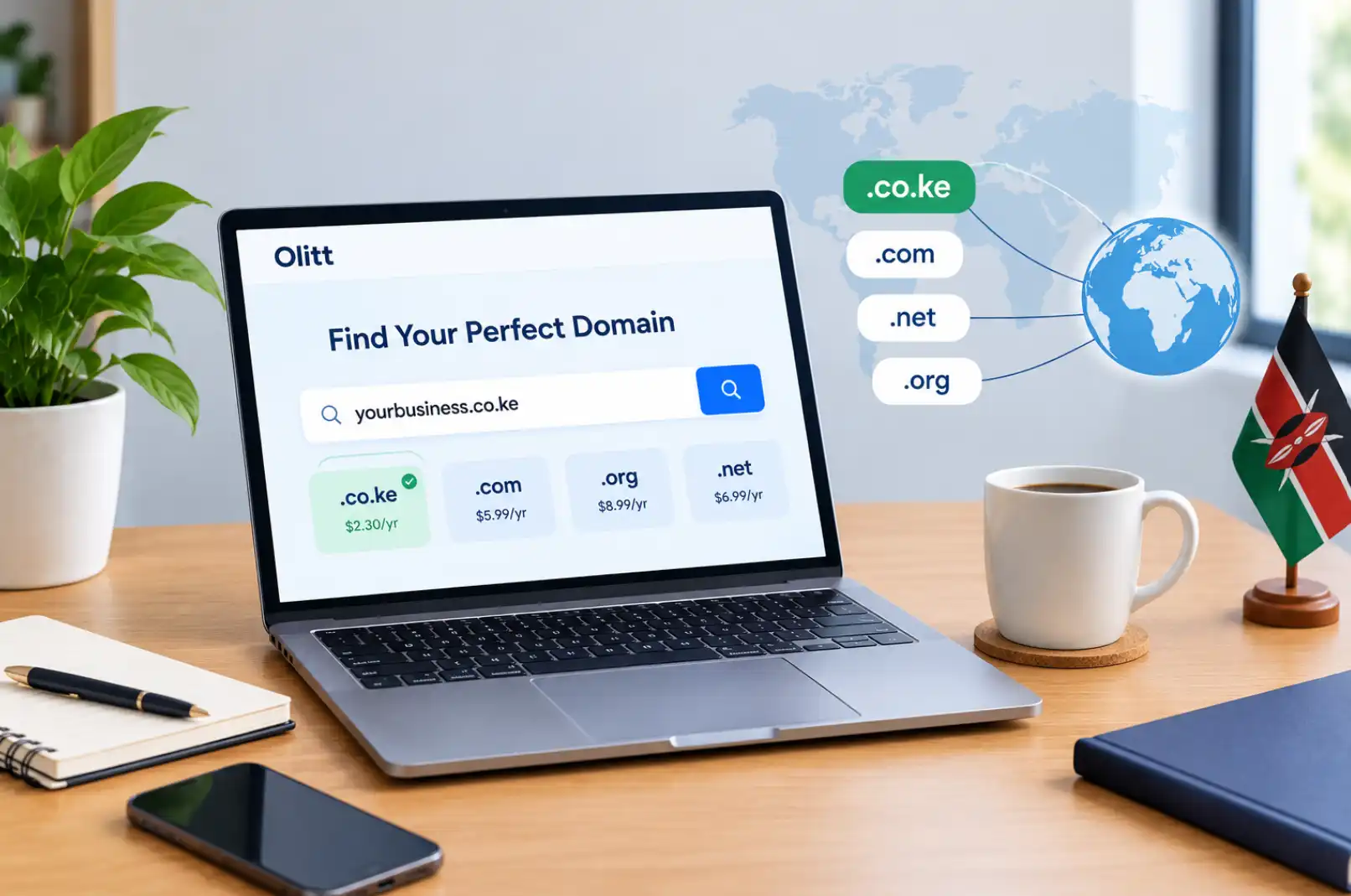
Search for available alternatives instantly using Olitt’s domain search tool, which shows multiple extension options and alternative suggestions alongside your primary search.
What If the Domain Is Parked With No Website?
A parked domain is a registered domain that displays a placeholder page or nothing at all. The owner is either sitting on it as a future asset or has simply forgotten about it.
Parked domains are worth pursuing directly. The owner has no active website to lose, which means their attachment to the name is lower than someone who has built a business on it.
Check the domain’s history using the Wayback Machine (web.archive.org) before you approach the owner. If the domain has a history of use under a recognizable brand, expect a higher asking price. If it has always been blank or parked, you are in a stronger negotiating position.
How Much Should You Offer for a Taken .co.ke Domain?
There is no fixed market rate for .co.ke domain resales. Prices range from a few thousand shillings for an obscure parked domain to hundreds of thousands for a premium short name with a business history.
A realistic starting range for a privately negotiated .co.ke domain with no active website or significant backlink history is between Ksh 5,000 and Ksh 30,000. Premium names with established traffic, history, or exact-match keywords to high-value industries command significantly more.
Do not start at your maximum. Open at roughly 30% of what you are willing to pay and negotiate from there. If the owner counters at a price beyond your budget, be willing to walk away, alternatives almost always exist.
Red Flags When Buying a Pre-Registered Domain
Not every domain on the market is worth buying. Watch for these warning signs before completing any purchase.
Spam or malware history: A domain previously used for spam, phishing, or malware can carry a Google penalty that damages your SEO from day one. Check the domain’s reputation before buying.
Trademark conflicts: Buying a domain that infringes on an existing trademark exposes you to a KENIC dispute or legal action even if you purchased it in good faith.
Inflated pricing from cybersquatters: If someone registered your exact brand name with the apparent intent to sell it back to you, that is cybersquatting. You may have legal recourse through KeNIC’s dispute process rather than paying the inflated price.
No written agreement: Any domain purchase should be documented in writing with clear terms covering the agreed price, transfer timeline, and what happens if the transfer fails.
How to Complete the Transfer After Buying
Once you and the seller agree on a price, the domain is transferred via an EPP authorization code also called a transfer code or auth code.
The process works like this:
- Seller requests the EPP code from their current registrar
- Seller provides the code to you
- You initiate a transfer at your chosen registrar – such as Olitt
- You enter the EPP code to authenticate the transfer
- The transfer completes within a few hours to a few days depending on the registrars involved
Olitt supports incoming domain transfers for .co.ke domains with a straightforward transfer process managed entirely from the dashboard.
Frequently Asked Questions
Can I force someone to sell me a .co.ke domain they are not using?
No. A registered domain belongs to its owner regardless of whether they are using it. You can only acquire it through negotiation, waiting for expiry, or filing a KENIC dispute if you have legitimate trademark grounds.
How long does a KENIC domain dispute take?
Mediation typically takes up to 15 days. If mediation fails, arbitration follows and a ruling usually comes within 60 days of the original complaint filing.
What if the WHOIS record shows privacy protection?
You cannot contact the owner directly. Use a domain broker who has tools to reach privacy-protected registrants, or monitor the domain’s expiry date and register it the moment it becomes available.
Is it safe to buy a domain through a third-party marketplace like Sedo?
Sedo and Afternic are established international platforms with escrow services that hold payment until the domain transfer is confirmed. This protects both buyer and seller. Always use escrow for transactions above Ksh 10,000.
What to do next
If your preferred .co.ke domain name is taken, the fastest path forward is often a smart alternative you can register and own immediately.
Search for your name and its variations right now using Olitt’s domain search tool. You may find that a .ke version, a location-modified name, or a slightly different structure is available today, and available means you can be live by the end of the afternoon.
If the exact name is worth pursuing through negotiation or monitoring, now you know exactly how to do it.