
Once you register your domain it becomes hard to change the name in the case you have gotten it wrong. Most registrars offers limited refund window for new registrations with conditions. Once you get it wrong You have to rebrand. You print new business cards. Your SEO starts over from zero.
Walk with me as I guide you through 10 mistakes to avoid when choosing a domain name. These trip up Kenyan business owners the most. Below each one, you will find how to avoid it.
1: Choosing a Name That Is Too Long
A long domain name is hard to remember. It is also easy to mistype on a phone.
Look at bestbakeryinnairobikenya.co.ke next to nairobibestbakery.co.ke. Both say the same thing. The second one is shorter and much easier to type.
Try to keep your name under 15 characters before the extension. Short names fit better on business cards. They are easier to say over the phone. People are less likely to get them wrong in a WhatsApp message.
2: Using Numbers Instead of Words
Using 4 instead of for, or 2 instead of to, can look smart on a logo. But it confuses people who hear your name out loud.
A customer who heard your business name on the radio has no way to know if you used the number or the full word. They will guess wrong. They will land on someone else’s site, or just give up.
The only time this is fine is when a number is part of your real brand name. A business actually called Studio54 can use studio54.co.ke.
3: Adding Hyphens
Hyphens cause more lost customers than people think. Nobody says the dash out loud. But everyone who tries to type your name from memory has to guess where it goes.
best-nairobi-bakery.co.ke and bestnairobibakery.co.ke sound the same when spoken. Someone who heard about you by word of mouth will almost always type the version with no hyphen. If that is not your domain, you just sent them to someone else.
4: Forgetting the Direct Navigation Test
This mistake is rarely talked about. It comes straight from how Kenyans actually use the internet.
Many people do not search for a website. They type the name they think it has straight into the browser. This is called direct navigation. Your domain needs to work even when nobody is searching for you.
Here is a simple test. Say your business name out loud. Ask someone to type what they think the website address is, without showing them anything written down. If they land on kenyaairways.co.ke and you registered kenya-airways.co.ke, you just lost that visitor.
5: Skipping the Swahili Meaning Check
A name that sounds fine in English can mean something different in Swahili. Most domain guides written outside Kenya never mention this check.
Here is an example. The word fiti is used in English to suggest fitness. Said in Swahili slang, fiti also means cool or great, so in this case it works well. But plenty of English words sound very different once said with Swahili pronunciation. The only way to know is to ask.
Before you register, say your domain name out loud to a few people who speak Swahili well. Ask if it sounds like any other word or phrase. A name that sounds clever to you alone can sound odd once it is spoken in a market where most people think in two languages at once.
This check takes five minutes. It can save you from a rebrand nobody wants to do six months later.
6: Picking a Domain Already Trademarked
Even a domain made of common words can be a trademark in someone else’s industry. If you register it anyway, you risk a legal dispute. You could lose the domain even if you registered it by mistake.
KeNIC’s dispute process covers cybersquatting, names too similar to existing trademarks, and bad-faith registrations. An independent panel reviews each case. They can order your domain transferred away from you if a complaint succeeds.
Before you commit to a name, run a quick search on the Kenya Industrial Property Institute website. Make sure the name is not already trademarked in your industry. You can also check Olitt’s guide on .co.ke domain registration requirements for more on staying safe from the start.
7: Tying Your Domain to One Product, Service, or Town
If your business is called nakurugreengrocers.co.ke and you later open a branch in Eldoret, your domain now works against you.
The same problem happens with product names. A business called bobsboots.co.ke that starts selling jackets too has a branding problem the moment it grows past boots.
Pick a name that is broad enough to grow with you. nakurufreshmarket.co.ke leaves room to expand to other towns. bobsoutfitters.co.ke leaves room to sell more than one type of product. Think five years ahead, not five months.
8: Ignoring the Renewal Price When You Register
This mistake has nothing to do with the name. It is about what happens after you click buy.
A domain advertised at a low price in year one can cost two or three times more to renew the next year. Many Kenyan business owners register based on that first low number. They get a bad surprise twelve months later.
Always check the renewal price before you register, not just the first-year price. Olitt shows both numbers on the same page. Renewal is set at Ksh 1,200 a year, so there are no surprises. For a full price breakdown, see Olitt’s guide on .co.ke domain price in Kenya.
9: Not Checking Social Media Availability
Your domain and your social media names should match. A business that is yourbrand.co.ke on the web but @yourbrand_official_2024 on Instagram creates confusion. It also makes the brand harder to find.
Before you register, check if the matching handle is free on the platforms your customers use. This means Instagram, Facebook, TikTok, and WhatsApp Business. You can also run a quick WHOIS lookup to make sure your chosen domain has no history under a different brand.
10: Choosing .com When .co.ke Serves You Better
Most naming guides tell everyone to pick .com. That advice does not always work well for a Kenyan business.
For Kenyan startups, .co.ke is almost always the better pick, unless every single customer is outside Africa. Local investors, M-Pesa users, and Kenyan shoppers trust .co.ke more. It also gives you a real local SEO advantage for searches done inside Kenya, something .com does not offer.
There is also a practical side to this. The .co.ke namespace has far less competition than .com. This means you have a much better chance of getting your exact brand name with no compromise.
Why These 10 Mistakes to Avoid When Choosing a Domain Name Matter So Much in Kenya
A wrong domain choice is not just a small detail. It changes how customers find you. It changes how much they trust your business. It can cost you real money to fix later.
Kenya’s digital economy is growing fast. Good, clean names are getting harder to find every month. Getting your domain right the first time saves you from a rebrand, a lost SEO history, and confused customers typing the wrong address into their browser.
Quick Reference: All 10 Mistakes to Avoid When Choosing a Domain Name
Use this table before you click register on any domain.
| Check | Why It Counts |
| Under 15 characters | Easier to remember, type, and say |
| No numbers replacing words | Avoids confusion when heard out loud |
| No hyphens | Removes a common typing mistake |
| Passes the direct navigation test | Works even without a search engine |
| Checked for Swahili meaning | Avoids any unwanted meaning |
| Not trademarked | Avoids legal trouble and forced transfer |
| Broad enough to grow with the business | Avoids a future rebrand |
| Renewal price confirmed | Avoids a surprise bill in year two |
| Social handles checked | Keeps your brand the same everywhere |
| Right extension for your audience | .co.ke for Kenya-focused businesses |
How to Register the Right Domain with Olitt Once You Have Chosen

Once your name passes all 10 checks, registering it takes just a few minutes.
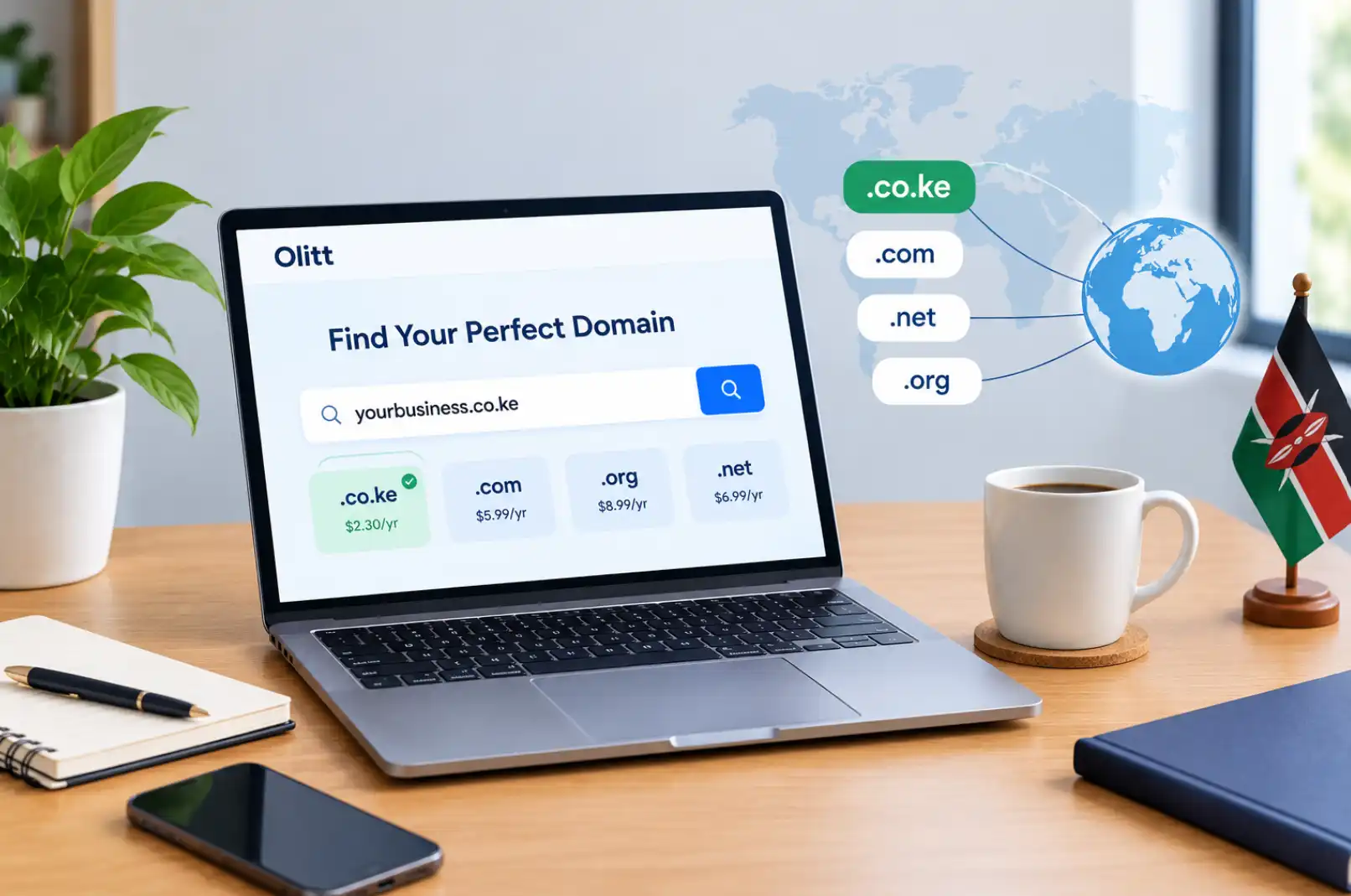
Search for your name using Olitt’s domain search tool. It checks live KeNIC availability and shows other options if your first choice is taken. Look at both the registration price and the renewal price on the same page before you add it to your cart.
Fill in your details using a business email you will keep for years. Pay with M-Pesa for instant activation, with no card fees added on top.
Before you close your dashboard, turn on auto-renew. Make sure domain lock is active too. These two settings stop the two most common ways Kenyan business owners lose a domain they have already built a brand around.
Frequently Asked Questions
What is the most common domain name mistake in Kenya?
Hyphens and numbers used in place of words are the most common mistakes. Close behind is choosing a domain too tied to one product, service, or town. Both make it hard for a customer to recall the name from memory.
Can I change my domain name after registering it?
You can, but it means registering a whole new domain and sending traffic from the old one over to it. You will rebuild your SEO history, update every printed item, and risk losing customers in the switch. It is much easier to get the name right the first time.
Should I register both the .com and .co.ke versions of my domain?
If your budget allows it, yes. This protects your brand and stops a competitor or cybersquatter from grabbing the other version. For most Kenyan businesses with local customers, .co.ke should be the main domain, with .com kept as backup.
What happens if I pick a domain name that copies someone’s trademark?
You risk a formal dispute through KeNIC. This can end with your domain taken away from you, even if you did not mean to copy anyone. Always check trademark records before registering a name close to an existing brand.
Get the Name Right the First Time
Avoiding these 10 mistakes to avoid when choosing a domain name is the difference between a brand that grows smoothly and one stuck doing an expensive rebrand within the year.
A domain name is one of the few business choices you truly cannot undo without real cost. Run your shortlist through all 10 checks above before you commit to anything.
Once you have a name that passes every test, register it today through Olitt’s domain search tool. Get your Kenyan online presence live with clear pricing, free WHOIS privacy, and instant M-Pesa checkout.